
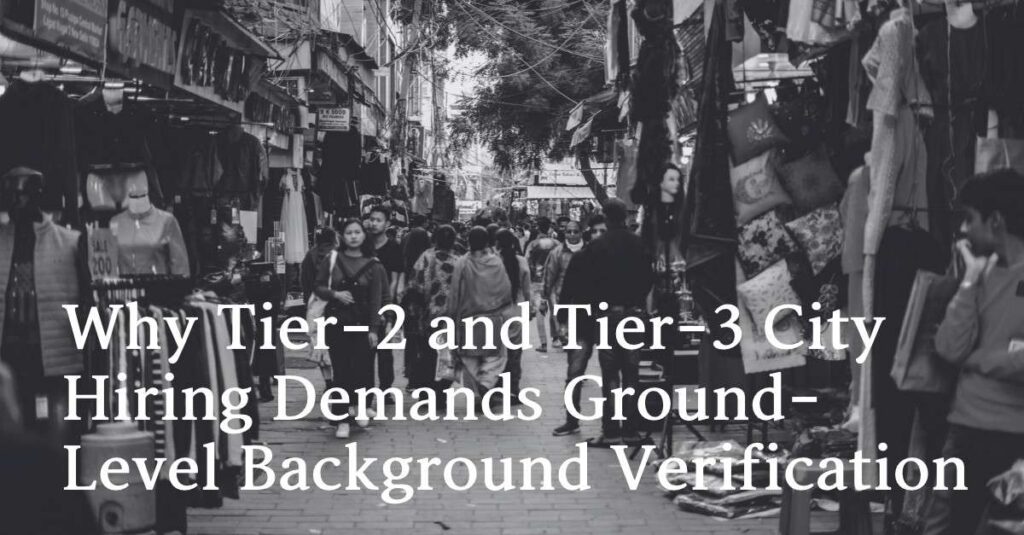
Why Tier-2 and Tier-3 City Hiring Demands Ground-Level Background Verification
India’s corporate growth story is no longer confined to Bengaluru, Mumbai, or Delhi-NCR. Over the last few years, a massive wave of expansion has pushed companies into smaller hubs like Indore, Jaipur, Coimbatore, Lucknow, and Surat. Lower office rents, improving roads and internet, and a huge wave of hungry young graduates make these towns hard for any business leader to pass up. Still, recruiting in smaller cities comes with its own set of blind spots. If you are an HR head or founder, counting only on online database checks in these markets leaves your company open to unnecessary risks. To actually keep your workplace and reputation safe, you need real, boots-on-the-ground background verification backing up your hiring decisions.
The Digital Gap in Emerging Talent Hubs
Most standard background verification processes rely heavily on centralized digital databases, automated APIs, and online court records. While this approach works reasonably well in metropolitan hubs where municipal and educational records are largely digitized, the reality in smaller towns is quite different.
Many local colleges, regional institutions, and small-to-medium enterprises in Tier-2 and Tier-3 cities still maintain physical ledgers. An automated search might return a blank slate—not because a candidate is fraudulent, but simply because the records are sitting in a filing cabinet rather than a cloud server. Conversely, a candidate might present fabricated credentials from an unaccredited local institute that lacks an online footprint, slipping right past standard digital filters.
Why Physical Checks Matter More Than Ever
Once you step outside big metros to hire, local paperwork and neighbourhood networks work by their own rules. Sitting at a desk making phone calls or sending emails usually gets you nowhere—or worse, gets you answers that are way too easy to fake. If you are bringing people on board from smaller cities, having real background verification people who verify details on the ground isn’t optional anymore.
- Confirming real home addresses: Lots of houses in growing towns don’t have neat street names or standard plot numbers. Sending a field executive to knock on the door lets them find the actual house, talk to a neighbour or local shopkeeper, and confirm the person genuinely lives there.
- Checking local police records: Online crime databases are getting better, sure, but plenty of district police stations still haven’t uploaded every single file. A background verification partner walking into the local station can spot pending cases or neighbourhood disputes that an online search would never catch.
- Visiting small local employers: Many candidates from smaller towns last worked at a family-run shop or regional business that doesn’t even own a corporate website or official HR email. Showing up at the office proves the business actually exists—and isn’t just a made-up name printed on a fake experience letter.
- Walking into college registrar offices: Emailing a regional college to verify a degree can mean waiting weeks for a reply that never comes. A field background verification agent can simply go to the registrar’s counter, pull out the physical ledger, and check the mark sheet on the spot.
Protecting Your Brand While Scaling Fast
When leadership wants to expand quickly, speed becomes everything. Still, skipping proper background verification checks to fill seats faster tends to backfire badly. Just one wrong hire in a new regional office can trigger money issues, data leaks, or compliance headaches that hurt your reputation both locally and nationwide.
Working with a background verification screening team that actually knows the terrain solves that problem. At Himadi, our field staff speak the local dialects, recognize regional paperwork, and know how municipal offices operate across India’s smaller towns. You get strict corporate compliance without losing touch with how things really work on the ground.
Hiring from Tier-2 and Tier-3 cities can give your company a huge edge—as long as your screening habits keep up with where you recruit. Putting real, ground-level background verification first lets HR leaders build strong, trustworthy teams anywhere in the country without taking blind risks.
